
Data sovereignty is often reduced to geography: where a server sits or which flag appears on a provider's website. Geography matters, but sovereignty also concerns who can issue administrative commands, who holds encryption keys, which laws apply, what subcontractors can access and whether the customer can leave without losing essential context.
These dimensions produce trade-offs. A local provider may offer residency but weak operational continuity. A global platform may offer mature security controls but create constraints around jurisdiction and external dependencies. No deployment model automatically guarantees sovereignty. The right architecture begins with concrete requirements and a threat model, not a slogan.
Practical mechanisms include encryption boundaries, tenant-specific access policy, auditable key management, a data map of subprocessors and tested export procedures. A service should distinguish customer content from operational telemetry and avoid retaining more than necessary. Meaningful control requires that administrators cannot quietly redefine the policy that users think they have.
A useful procurement question is: what remains under the customer's control during a dispute, an outage or an exit? Sovereignty is not solved by one hosting choice. It is negotiated across legal rights, technical controls and operational independence, then verified through evidence.
Three controls that do not travel together
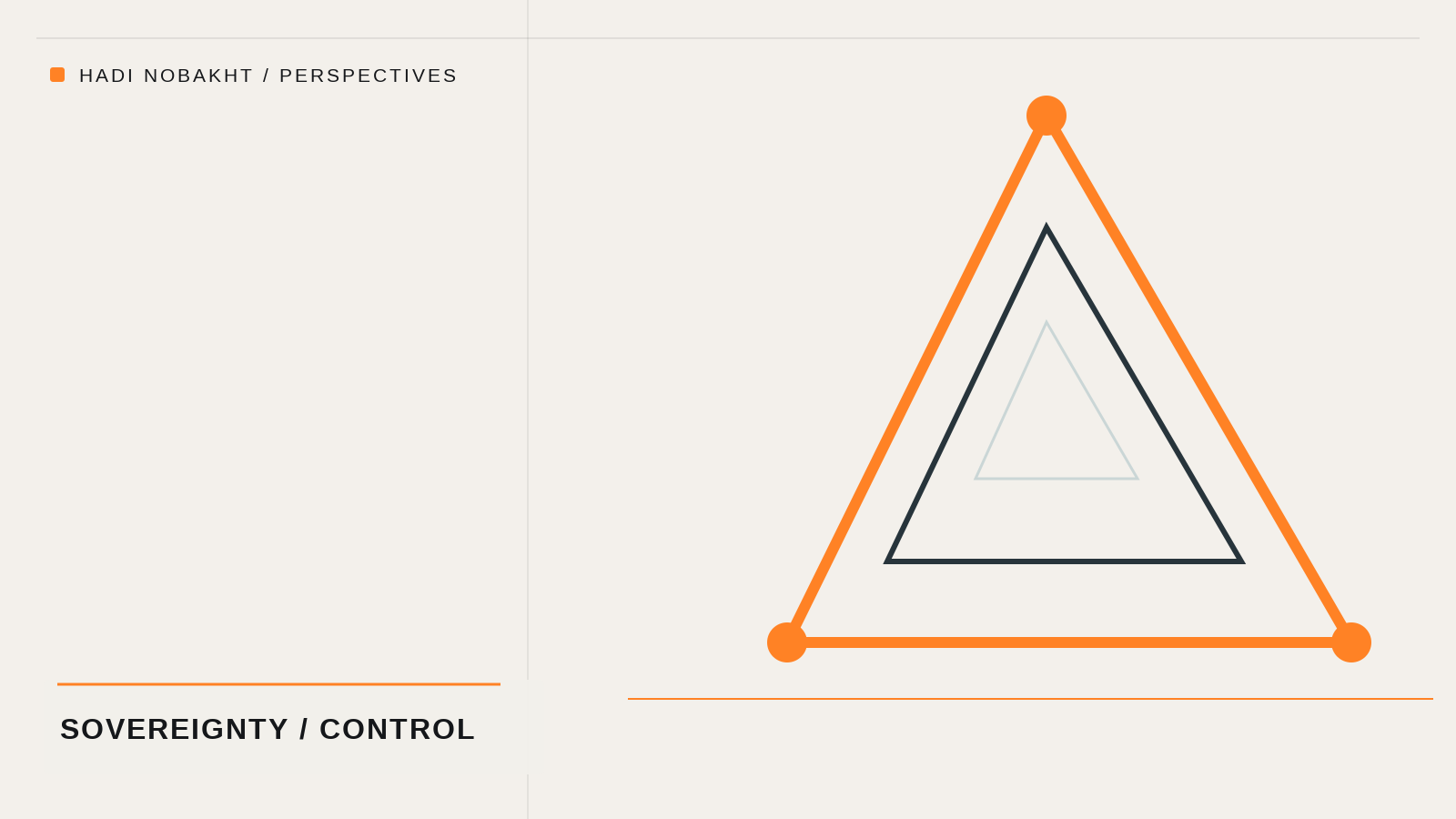
When a company says its data is sovereign, ask who holds the encryption keys, who can operate the infrastructure and who can lawfully compel disclosure. A server inside a country's border answers only part of that question. Residency concerns physical location; jurisdiction concerns applicable authority; operational control concerns the ability to inspect, move, suspend and recover a workload. Treating these as synonyms makes purchasing decisions feel simpler while hiding the real dependencies. A sound architecture draws the triangle explicitly: where information lives, which legal relationships govern it and which operator can exercise real control.
Example: a regional analytics platform
Imagine a healthcare-adjacent organization that stores customer records in a local region, processes analytical questions using a remote model provider and keeps backups with a third infrastructure company. Every vendor may truthfully advertise a data-residency option, yet identifiers, prompts or derived results can cross organizational boundaries. The correct design traces each data class through ingestion, semantic enrichment, inference, logging, backups and deletion. It asks about subcontractors, model-training permissions and the ability to restore without the original provider. Sovereignty becomes a testable map of relationships, not a flag in a cloud console.
The serious counterargument
Absolute autonomy is often economically irrational. Rebuilding modern cryptography, cloud networking or a trustworthy model stack in-house can reduce reliability and consume attention that belongs to the product. In some cases a reputable shared provider improves security and availability. The question is not whether dependence can be eliminated, but whether it is known, bounded and reversible at a tolerable cost. Legal requirements can also conflict across territories. Marketing language cannot settle that conflict; professional legal review and specific technical controls are necessary.
A procurement exercise that reveals more than a logo
Ask a vendor to identify all subprocessors, data movement paths, export formats and the operational process for an emergency freeze. Request evidence for tenant separation, access logging, encryption-key custody, deletion and disaster-recovery exercises. Then test one representative migration rather than accepting a presentation about portability. Measure time to verified export, time to revoke credentials and time to reconstruct a usable environment. The cost of leaving should be understood before the first invoice is paid.
My conclusion
I think of sovereignty as the practical ability to make choices about information. A system is not meaningfully sovereign simply because the website says where its servers are. It approaches that goal when the customer understands the contracts, can verify the technical boundaries and has a realistic exit path. That is a more demanding promise—and a more credible one.